Simple Outfits for Men: Seven Basics, and Only Five Work
The seven pieces every list of simple outfits opens with make twelve combinations, and five of them hold. Swap two and all twelve do, for $302. Plus the willpower argument for dressing simply, which returned an effect size of 0.04 across 23 labs.
A simple outfit is one where no piece sits more than a rung of formality from any other piece in it. Seven garments chosen that way make twelve outfits, which is a week with five to spare, from $740 a look at prices checked September 2026. The seven basics usually recommended make five, because a white T-shirt and white sneakers sit two rungs below the shirts and the boots and share a single outfit between them. The willpower argument for dressing simply, meanwhile, rests on an effect measured at 0.04.
The white tee and the white sneakers open every list of these. They are also the two pieces that cost you the week.
0.04
Effect size for the willpower saving the uniform argument rests on, across 23 labs and 2,141 people. The confidence interval includes zero
6x
How much more attention people expected their shirt to get than it actually got, when both were measured
5 of 12
Outfits from the seven basics every list starts with that hold up. Two swaps, $302, takes it to twelve of twelve
The uniform argument rests on research that did not replicate
Almost every case for dressing simply traces back to one paragraph. Michael Lewis asked Barack Obama about the suits for Vanity Fair in 2012, and got this: “You’ll see I wear only gray or blue suits. I’m trying to pare down decisions. I don’t want to make decisions about what I’m eating or wearing. Because I have too many other decisions to make.” Lewis notes in the next line where the idea came from. Obama mentioned research showing that the simple act of making decisions degrades your ability to make further ones.
That research is ego depletion, and four years later twenty-three laboratories ran a preregistered replication of it on 2,141 people. The pooled effect came out at 0.04, with a confidence interval running from -0.07 to 0.15. The meta-analysis that made the idea famous had put it at 0.62. Only three of the twenty-three labs found an interval that excluded zero, and one of those three pointed the wrong way.
The authors are careful and it is worth being careful with them. They write that it may be premature to reject the effect altogether on one set of data, and their protocol tested a letter-crossing task followed by a reaction-time task, not a man standing in front of a wardrobe at seven in the morning. Nobody has measured what choosing trousers costs you by four in the afternoon. What can be said is that the benefit everyone repeats has never been shown.
So if the willpower saving is not the reason, what is left?
Nobody is keeping count
Fifteen students at Cornell were handed a T-shirt with a face on it they had picked out themselves, from Bob Marley, Jerry Seinfeld and Martin Luther King Jr, and asked to walk into a room where four or five other people were filling in a questionnaire. Then they guessed how many of those people would be able to say who was on the shirt. Their guesses came in six times higher than the observers actually managed, a gap of 40 percentage points with a confidence interval from 21 to 59.
Keep the claim the size it is. This measures whether strangers can recall an image after a couple of minutes, not whether the person at the next desk registers that the navy sweater is back on a Thursday. It is the closest measurement there is and it points one way. The audience you are building a rotation around is smaller than it feels from inside.
Which leaves the case for keeping it simple resting on arithmetic rather than on either of the two things it is usually sold on. A small set of clothes that all work together produces more outfits than a larger set that does not.
Three of the twelve
Seven garments, three tops and two bottoms and two shoes, at prices checked in September 2026 and pulled from the MVRCK catalog, which is mine. Three of the twelve combinations are below, picked so that between them they use all seven pieces.
Saturday, and most of the week
The bottom of the range, and still not a T-shirt
Chambray, indigo denim, brown suede. The shirt is the piece doing the work: it has the visible weave and the work-shirt history that read casual, so it sits level with the jeans, and it still has a collar, so it reaches the chinos and the boots too. A T-shirt in this slot reaches neither.


A weekday that matters
The one that passes for dressed without a jacket
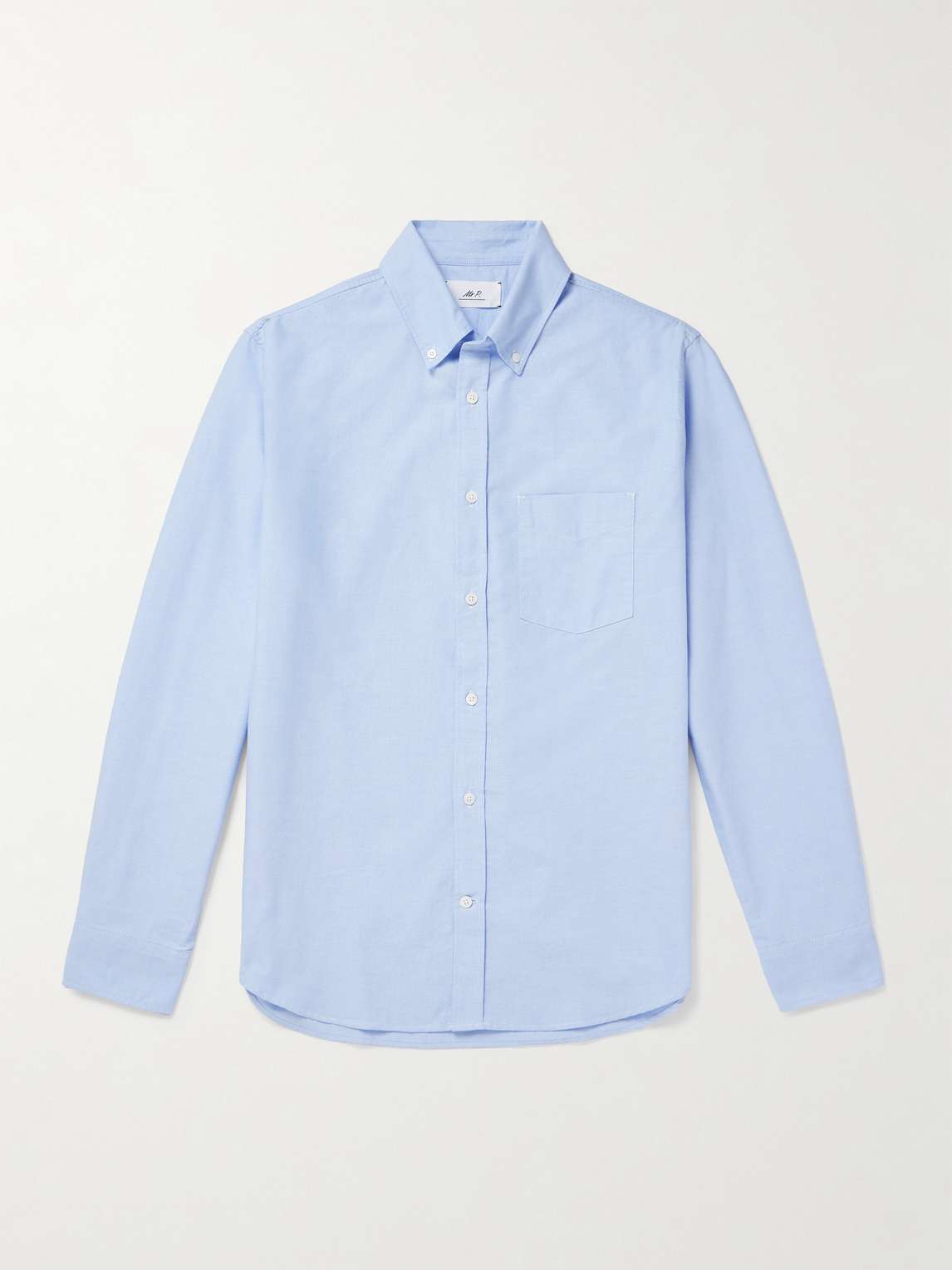
The oxford shirt over beige chinos, on desert boots. Every piece is plain, matte and sombre, which is what reads considered rather than smart, and the cotton twill of the chinos keeps it a rung under a wool trouser. This is the look that covers a lunch, an office that stopped caring, and a table booked at seven.


After dark
The dark one, and the most expensive of the twelve
Navy merino over the same jeans, with the boots instead of the loafers. Fine-gauge wool is smooth and plain, so it climbs, and it goes over the chambray or the oxford when it gets cold without changing what level the outfit is at. At $930 it is the top of the range here, and the sweater is $285 of it.

Those three cost $795, $770 and $930. Across all twelve the cheapest is $740 and the dearest is the one above at $930, so the whole range a week can land in is $190 wide. Owning the seven is $1,850.
Seven basics, five outfits
Here is the set every list of simple outfits recommends, matched piece by piece to real listings: a white T-shirt at $80, a navy merino crew at $285, a blue Oxford at $180, dark jeans at $250, beige chinos at $195, white leather sneakers at $163 and brown suede desert boots at $395. That is $1,548, and three tops by two bottoms by two shoes is twelve outfits on paper.
The check is a formality one, and the placements are not new: these garments sit on the same rungs they were put on when the count was run over a twelve-piece wardrobe. An outfit holds if its furthest-apart pieces sit within a single level of each other. The tee and the sneakers are level 1, the jeans level 2, everything else level 3. I counted all twelve.
| The combination | Rungs it spans | One-level rule |
|---|---|---|
| White T-shirt, jeans, white sneakers | 1 to 2 | Holds |
| White T-shirt, jeans, desert boots | 1 to 3 | Clashes |
| White T-shirt, chinos, white sneakers | 1 to 3 | Clashes |
| White T-shirt, chinos, desert boots | 1 to 3 | Clashes |
| Merino crew, jeans, white sneakers | 1 to 3 | Clashes |
| Merino crew, jeans, desert boots | 2 to 3 | Holds |
| Merino crew, chinos, white sneakers | 1 to 3 | Clashes |
| Merino crew, chinos, desert boots | 3 only | Holds |
| Oxford shirt, jeans, white sneakers | 1 to 3 | Clashes |
| Oxford shirt, jeans, desert boots | 2 to 3 | Holds |
| Oxford shirt, chinos, white sneakers | 1 to 3 | Clashes |
| Oxford shirt, chinos, desert boots | 3 only | Holds |
Five hold. The white T-shirt is in one of the five. The white sneakers are in one of the five, and it is the same one: tee, jeans, sneakers, which is the best-known outfit in menswear and is in no trouble at all. The desert boots carry the other four on their own.
So two of the seven purchases, $243 of the $1,548, buy one outfit between them, and one of the seven appears in four. That is a difference in how often each gets worn, which is the half of dividing a price by a number of wears that you can count instead of forecast.
Two swaps, and all twelve hold
Change two things. The T-shirt becomes a chambray shirt at $160, which has the visible weave and the work-shirt history that keep it casual but still has a collar. The sneakers become brown suede penny loafers at $385, which have a nap where a dress shoe has a shine. Both moves are one rung, and both are into the middle.
3 tops
- Chambray shirt, $160
- Blue Oxford shirt, $180
- Navy merino crew, $285
2 bottoms
- Indigo jeans, $250
- Beige chinos, $195
2 shoes
- Brown suede loafers, $385
- Brown suede desert boots, $395
7 pieces, multiplied
12 outfits
All twelve hold, and it is worth saying plainly why: nothing in the set is more than one rung from anything else, so there is nothing left for the rule to take out. That is not a finding. It is the design rule read backwards, and it is the whole method.
Simon Crompton builds the same thing at four times the size. Permanent Style's complete capsule runs to sixteen numbered pieces, and he states the objective in one sentence: “the objective is for everything to go with everything, so the clothes can be swapped around and produce the maximum number of combinations”. On how you get there he is blunt. It “is much easier with things that don’t have strong colour or pattern”. His sixteen covers tailoring and more of the year than seven ever will, and the rule does not change with the size.
The swap costs $302 and takes five wearable outfits to twelve, which is $43 for each one gained. Put another way, the basics set works out at $310 per outfit you can actually leave the house in, and this one at $154. Multiplying tops by bottoms by shoes gives you the ceiling, which is how nine pieces get described as twenty-seven outfits. What you get is the ceiling minus whatever the formality check removes, and on a set this narrow it removes nothing.
Which is roughly why I built MVRCK. You ask in a sentence and the whole look comes back at real prices with live stock, bought through to the retailer, and you can put it on your own avatar before you spend $385 finding out how a loafer sits on you. Photograph what is already in your wardrobe and it styles from that too, your own pieces and the catalog mixed into one outfit, which matters here more than usual. Some of these seven are probably already hanging up, and the count worth having is the one your wardrobe makes, not this one.
Four things people say about dressing simply
-
Dressing simply frees up mental energy for the decisions that matter
This is the reason almost everyone gives, and it comes from a laboratory effect that returned 0.04 across 23 labs and 2,141 people, with a confidence interval running through zero. Nobody has measured what picking trousers costs you by the afternoon. Dress simply for the outfits, not for the willpower.
-
People notice when you wear the same things over again
Students wearing a face they had chosen to be seen in guessed six times more observers would recall it than actually did. The measurement is about a novel image over a couple of minutes, so treat it as the ceiling rather than the number, and the ceiling is low.
-
White sneakers go with everything
They go with the casual end and stop. In the seven basics counted on this page they reach one outfit in twelve, and it is the tee and jeans one, which is a good outfit and the only one they are in.
-
Plain and subdued is what makes a small wardrobe work
Simon Crompton puts it in a line: everything going with everything “is much easier with things that don’t have strong colour or pattern”. A pattern or a bright colour has to be matched by whatever it sits next to, and a small set has nothing to spare.
The opinion, and it is only that: keep the white sneakers. They make one outfit here and it is a good one, and a wardrobe built to maximise a count is a spreadsheet rather than a set of clothes. Just buy them knowing that is what they are, instead of believing the line about going with everything.
Common questions
What are some simple outfits for men?
A chambray shirt with indigo jeans and brown suede loafers. An Oxford shirt with beige chinos and desert boots. A navy merino crew with either bottom and the boots. Those three use seven garments between them, and the same seven make nine more combinations that work, from $740 to $930 a look.
How many clothes do I actually need?
Three tops, two bottoms and two shoes gets you twelve outfits, which covers a week with five to spare. Permanent Style’s complete capsule runs to sixteen numbered pieces, and it is aimed at a man who wears a jacket most days. Seven is the floor for a life without tailoring in it.
Is it bad to wear the same outfit every day?
No, and fewer people clock it than you think. In the one study that measured this, participants overestimated how many observers would notice what was on their shirt by a factor of six. Wearing something twice in a week is a decision about your own boredom rather than anyone else’s attention.
Does having a uniform save mental energy?
There is no good evidence that it does. The idea traces to ego depletion, and a preregistered replication across 23 labs and 2,141 participants put the effect at 0.04 with a confidence interval running through zero. The authors say it is premature to reject the effect outright, which is fair, but it is not a benefit anyone has shown.
What are the basics every man should own?
The usual seven are a white tee, a navy crew, an Oxford shirt, dark jeans, chinos, white sneakers and brown boots. Five of their twelve combinations survive a formality check. Swap the tee for a chambray shirt and the sneakers for suede loafers and all twelve do, which costs $302 and buys seven outfits.
Why do my clothes not go together when they are all basics?
Usually because two of them sit at opposite ends of the formality range. A white sneaker and an Oxford shirt are both basics and they sit two rungs apart, so the outfit reads as effort that missed rather than as a mistake you can point at. Look at the shoes first.
Go and lay out everything you would call a basic, then pair each top with each bottom and each pair of shoes and put the ones that clash back. Whatever number you land on is the real size of your wardrobe, and it is almost never the number of things in it.
- Obama's Way · Michael Lewis, Vanity Fair
- A Multilab Preregistered Replication of the Ego-Depletion Effect · Martin S. Hagger, Nikos L. D. Chatzisarantis and others, Perspectives on Psychological Science
- The Spotlight Effect in Social Judgment · Thomas Gilovich, Victoria Husted Medvec and Kenneth Savitsky, Journal of Personality and Social Psychology
- A complete capsule wardrobe · Simon Crompton, Permanent Style