Best Casual Outfits for Guys: Five Rungs, Seven Pieces
Six menswear authorities read in full, and they disagree on dark jeans and clean sneakers. Debrett’s manages both answers on one page. Five ranked looks from weekend to smart casual, each one garment apart, at real prices from $865.
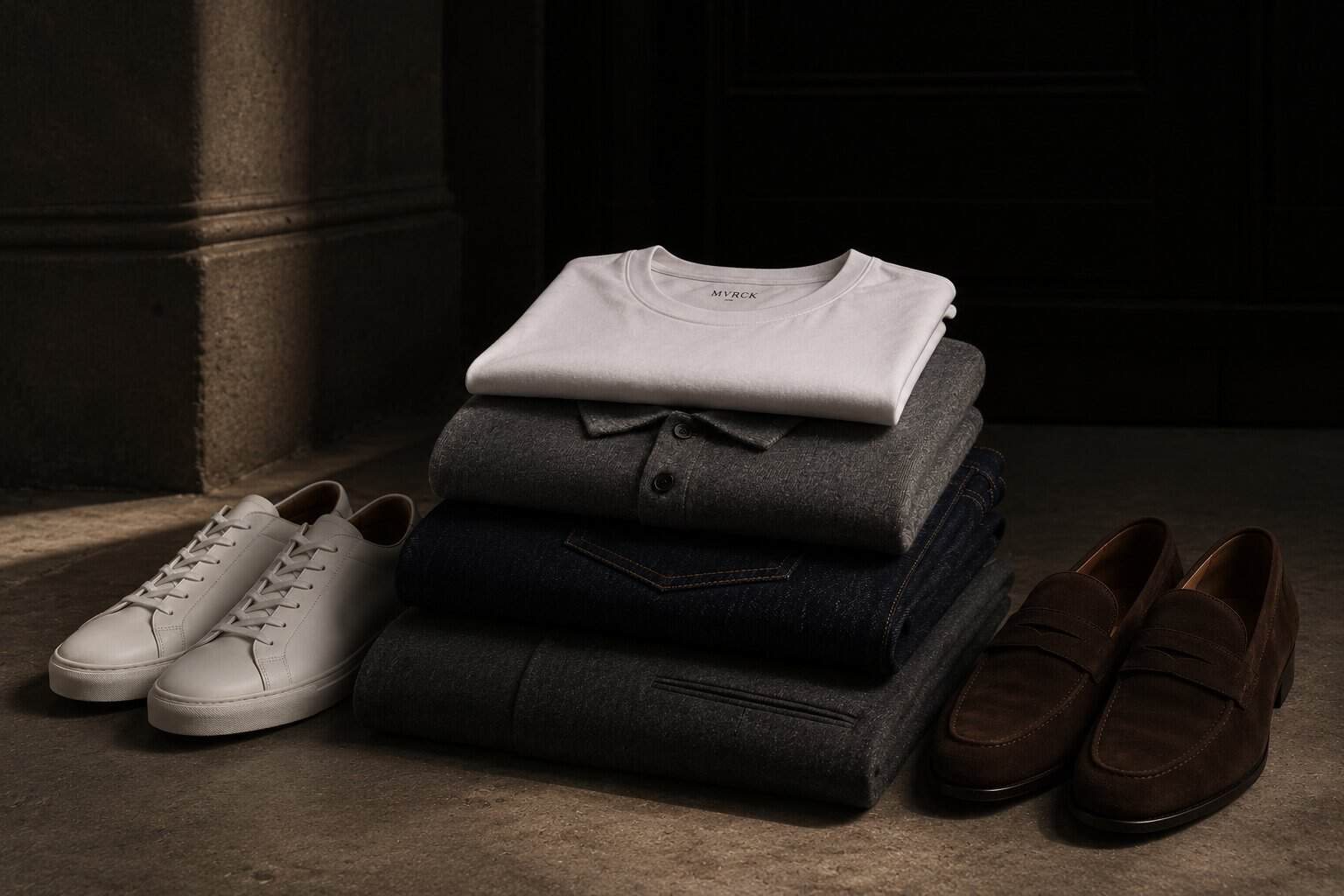
There is no single best casual outfit, and that is the actual finding. We read six of the most-cited menswear guides in full in September 2026 to work out where casual ends, and they do not agree. Three permit dark jeans outright, one bans them, and Debrett’s does both on its own website. So this page ranks five looks instead, from a Saturday with nothing planned to the dressiest thing still called casual, $865 to $1,455. Each one changes exactly one garment from the look before it. Seven pieces cover all five.
The useful part is what the swaps cost. Going up this ladder is cheaper than staying at the bottom of it, for reasons that have nothing to do with taste.
7
Pieces behind all five looks, spanning the whole casual range from weekend to smart
$105
Less than the sneakers cost, for the dressier shoe that replaces them
$20
Separates the most casual look here from the one four rungs above it
Casual is a range, and the guides disagree where it ends
Every guide to casual clothes opens by defining the term, and they all define it the same way: above a tracksuit, below a suit. MR PORTER calls it the middle ground between sweatpants and suit and tie. Gentleman’s Gazette puts it between a very casual outfit and a formal or businesslike one. That is a range roughly as wide as your whole wardrobe, which is why the definition has never helped anybody.
The disagreement starts the moment you ask about a specific garment. So we asked about the two you already own.
| Source | Dark clean jeans | Clean leather sneakers | In its own words |
|---|---|---|---|
| Debrett’s | Both | Both | Bans and permits each, across its own pages and twice within one of them. |
| Gentleman’s Gazette | No | No | “No jeans, no trainers, no hoodies, or no sweatpants.” Shoes must be leather and “must not be black”. |
| MR PORTER | Yes | Not addressed | Describes “dressing up a pair of selvedge jeans or tailored shorts with an unstructured blazer”. |
| FashionBeans | Yes | Yes | Jeans are “perfectly acceptable” if dark and undistressed; smart sneakers get their own recommendation. |
| The Modest Man | Yes | Yes | “Jeans can be smart and a blazer can be casual.” Dark-wash jeans are called a staple. |
| Esquire | Not directly | Yes | Reports the goalposts moved: the suit-and-sneaker combination shifted what counts as smart. |
Six sources, read in full rather than skimmed for a quote. On dark clean jeans, three say yes, one says no, one says both, and one addresses the question only sideways. On clean leather sneakers it is three yes, one no, one both, and one that never raises it. There is no majority you could safely round to a rule, and the split is not between serious and unserious sources. It runs straight through the middle of the ones men actually cite.
This is worth sitting with, because the reasonable conclusion from years of reading these guides is that you are missing something everyone else understood. You are not. The guides are not converging on a rule you failed to learn.
Worth noting how unusual that is. When we read twelve published nightlife dress codes the same way, the venues agreed with each other almost completely: all twelve banned athletic wear, and none banned jeans or sneakers. People who have to enforce a rule at a door write a clear one. It is the guides written for readers who will never be checked that cannot settle on an answer.
The one authority that disagrees with itself
Debrett’s is the closest thing to a governing body this subject has. It is also, on the specific question of what you may put on your feet, three different answers on one page.
Read its guide to dress codes from the top. It opens by telling confused guests they “should not simply opt out and come in your jeans and trainers”. Its smart casual section then describes the code as a request not to turn up in everyday leisure clothes, listing “trainers, jogging pants, sweatshirts, hoodies, beachwear, flip-flops”. Under formal smart casual it says to wear “loafers, brogues or lace-ups, not trainers or sandals”. Then, four paragraphs later, under informal smart casual, it tells you to “wear smart trainers or deck shoes”.
Jeans go the same way. The formal tier asks for chinos, in the words “not jeans”, and the informal tier on that same page says the code “can usually be interpreted as jeans for men but smart, clean, dark-coloured jeans”. A third Debrett’s page, on whether dress codes matter, says to “wear leather shoes, not trainers or sandals” and that denim, “even designer denim, is probably too casual”.
None of that is sloppiness. It is what happens when one phrase has to cover a birthday drink in the country and a printed invitation in the city, which Debrett’s says explicitly and is right about. But it does settle the question of whether there is a rule to look up. The most authoritative source available gives you two answers and tells you the context decides.
Four things men believe that the sources do not say
-
Casual means one thing, and I keep guessing it wrong.
It is a range, not a setting, and the six guides read for this page put its top edge in different places. You have not been failing to learn a rule. You have been trying to obey six of them at once, one of which contradicts itself.
-
Dark jeans are not smart enough.
Three of the six name dark, clean, well-fitting jeans as acceptable outright, and only Gentleman’s Gazette rules them out. Every source that permits them attaches the same conditions, and not one of those conditions is about price. Dark, clean, no distressing, fits properly.
-
Sneakers are the thing that gives you away.
Where a source permits them, the qualifier is always condition rather than category: clean, minimal, leather, unscuffed. The published nightlife dress codes we read separately reach the same answer, with none of twelve banning sneakers as a category. Gentleman’s Gazette is the one flat no here.
-
Dressing up means buying dressier, so it costs more.
Not on this page. The suede loafers cost $105 less than the sneakers they replace, and the whole four-rung climb from the most casual look to the smart-casual one lands $20 apart. Only the blazer at the very top costs real money.
What all six agree on: three dials
Where the sources stop arguing is on mechanism. Every one of them describes the same three ways to move an outfit up or down the range, and none of the three is a list of permitted garments.
Swap one piece, or better, two. FashionBeans puts it most precisely: start with a casual outfit and change one or two pieces for smarter alternatives, and “swap in three and, depending on the circumstances, you might even be too smart”. That is a ceiling as well as a method, and it is the reason the ladder below moves one garment at a time.
Turn the shade down. Darker skews formal, and you can move a look without changing a single garment. Esquire says darker tones are generally dressier and brights pull things more casual. The Modest Man makes the same point from the other end, noting that shade and fabric are what decide the formality of a piece.
Roughen the texture. The most formal things in menswear are smooth and shiny, so texture reads as casual: matte flannel, tweed, suede, brushed cotton. This is why a suede loafer can sit under jeans and a polished black oxford cannot, and why an unstructured cotton blazer is a different garment from a suit jacket.
Underneath all three sits the thing the sources genuinely never disagree about, put best by Sir Hardy Amies in his A-Z of Style and quoted by FashionBeans: “Smartness is more a matter of the appearance of your clothes rather than their style.” A pristine tee, indigo jeans and clean trainers beat a wrinkled shirt and scuffed shoes in every guide on this page. Condition outranks category everywhere, and it is free.
The ladder: five looks, seven pieces
Five complete outfits, ordered from the bottom of the casual range to the top. Each changes exactly one garment from the one above it, so you can diff any two neighbours and find precisely one difference. Every piece is a real listing from the MVRCK catalog, which is ours, with live prices and stock behind it. Totals are head to toe and include the shoes.
If you would rather have five unrelated looks than one chain, our ten complete outfits priced whole do that job instead. This page is the other question: not which outfit, but how far apart any two of them really are.
-
Saturday, nothing planned
$865White tee, indigo jeans, white leather sneakers. The floor, and the outfit you already own.
-
Dinner somewhere unbooked
$1,080White T-shirt Grey merino polo
The collar. The single most useful swap on the ladder and the first line every guide draws.
-
A date, a nice restaurant
$975White sneakers Brown suede loafers
The shoe, which is where the range is really decided and the swap most men skip.
-
An invitation that says smart casual
$885Indigo jeans Grey wool trousers
The rung that satisfies all six sources at once, including the one that rules out denim.
-
The dressiest thing still called casual
$1,455Adds Unstructured navy blazer
The ceiling, and the only rung reached by adding a piece rather than trading one.
Read the totals column downward and the thing this page exists to say is already visible. The number goes up once, at the collar, and then falls for two straight rungs while the outfit gets steadily dressier. Only the blazer sends it up again.
The bottom two rungs
The first look is the one nearly every man reading this already owns some version of, and the guides are kinder to it than he expects. The second changes one garment and crosses the line all six of them draw first.
Saturday, nothing planned · $865
White T-shirt, indigo jeans, white leather sneakers
The bottom rung, and the outfit most men reading this already own some version of. Every piece is doing the one thing the guides actually ask for, which is being in good condition: the tee is midweight rather than washed thin, the denim is a deep indigo with no distressing anywhere, and the sneaker is full-grain leather with no branding on it beyond a small gold stamp. Nothing here is trying. That is the point of the rung.
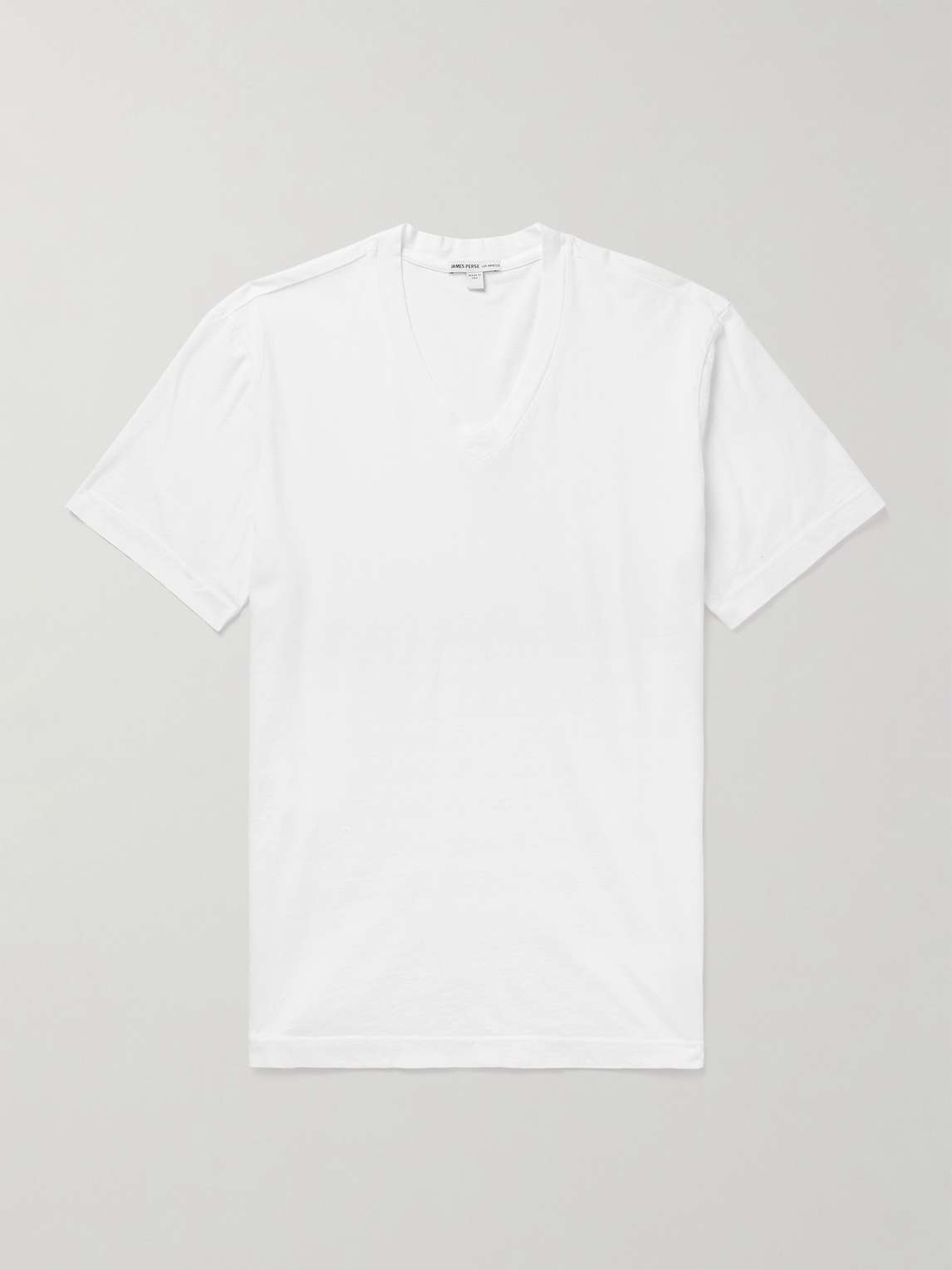


Dinner somewhere unbooked · $1,080
The same jeans and sneakers, with a merino polo instead of the tee
One garment changes and the look crosses the line almost every guide draws first, which is the collar. Fine-gauge merino rather than piqué cotton, so it reads closer to a good sweater than to golf, and long-sleeved, which is what lets it sit under the blazer four rungs up without looking like a layering accident. This is the single highest-value swap on the page and the reason the polo, not the blazer, is the piece doing the most work.

The collar is the highest-value swap on the ladder, and the polo rather than the blazer is the piece doing the most work on this page: it appears in four of the five looks. It is also the swap that costs the most, at $215, which is the one place where dressing up here behaves the way you would expect it to.
The middle: where the shoe decides
Men swap the top half and stop. Both of the next two rungs happen below the knee, and together they are what move an outfit from acceptable to correct without anything being added to it.
A date, a nice restaurant · $975
The polo and jeans, with suede loafers instead of the sneakers
The shoe is where the casual range is actually decided, and it is the swap men skip. Brown suede rather than smooth calf, because suede is the texture that keeps a penny loafer from reading as office footwear, and brown rather than black for the same reason. This look is the first one on the page that no source on it would argue with, and it costs $105 less than the look above.

An invitation that says smart casual · $885
The polo and loafers, with grey wool trousers instead of the jeans
The rung that settles the argument the guides are having. Swap the denim for a straight-leg wool blend and the outfit satisfies every source on this page, including the one that rules out jeans outright, without adding a single piece. Grey rather than charcoal so it sits under a navy jacket without turning into a broken suit, and pleated, which is the detail that stops a wool trouser reading as suit salvage.

The fourth rung is the one that ends the argument the guides are having. Trade denim for a wool trouser and the outfit satisfies all six sources at once, Gentleman’s Gazette included, without a piece being added and without anyone at the event being able to say what changed. It is the cheapest way to stop having to guess which guide your host reads.
The ceiling, and where casual stops
The blazer is the only rung reached by adding rather than trading, and it is where the range runs out. Above this you are not at the top of casual, you are dressed for a different code.
The dressiest thing still called casual · $1,455
All of it, plus an unstructured navy blazer
The ceiling, and the only rung reached by adding rather than swapping. Unstructured, patch-pocketed and cut in cotton twill rather than worsted, which is three separate ways of keeping a jacket from reading as the top half of a suit. Above this you are not smart casual any more, you are dressed for something else. It is also the one step on the page that costs real money, which is worth knowing before you decide you need it.

Three details keep a jacket from reading as the top half of a missing suit, and this one has all three: unstructured, so there is no padding or canvas holding a shoulder line; patch pockets, which are stitched on rather than set in; and cotton twill rather than worsted, which is the texture dial. The closer match in the catalog on paper was a navy linen-blend from Ralph Lauren, ruled out on a detail FashionBeans borrows from Debrett’s, which files gold buttons under “gin and Jag”. That jacket has rows of them.
Climbing costs less than staying put
Here is the part no guide mentions, because no guide is looking at prices while it writes. Checked in September 2026, the two swaps that do the most to dress this outfit up both save money.
The brown suede loafers are $385. The white leather sneakers they replace are $490. The dressier shoe is $105 cheaper, at full price on both, no sale involved. The grey wool trousers are $205 against $295 for the indigo jeans, another $90 down, though that pair is currently reduced from $410 and will not always sit below the denim. Which means the smart-casual look at rung four, the one that satisfies every source on this page, costs $885 against $865 for the weekend outfit at the bottom. Twenty dollars separates them today, and the cheaper one is the one you would wear to buy coffee. The shoe result is the one that holds whatever the prices do, because neither shoe is discounted.
The blazer is the honest exception. At $570 it is the single most expensive piece here and the one step that genuinely costs something, which is worth knowing before you decide the top rung is the one you need. Four rungs of this ladder are a rearrangement. Only the fifth is a purchase.
None of this is a trick of the catalog. A minimal white leather sneaker is a category where the design is the product and people pay for it accordingly, and a suede loafer is a category with two centuries of competition in it. The general lesson survives the specific prices: the casual end of your wardrobe is where the money quietly goes, and the assumption that dressing better means spending more is the most expensive thing most men believe about clothes. Divide thirty staples by the number of times each one gets worn and the price tag survives the exercise almost intact, which is the same lesson arriving from the other direction. It is also why what people pay for styling advice so rarely matches what the advice is worth.
The seven pieces, and what each one carries
Five outfits spanning the entire casual range, out of seven garments. Every filled square is a look that piece appears in, so the count is checkable by eye. Run the same count over a twelve-piece core wardrobe and 108 possible outfits come down to 24.
| The piece | Weekend | Dinner | Date | Smart | Ceiling | Looks |
|---|---|---|---|---|---|---|
| White cotton T-shirt $80 | worn in Weekend | not worn in Dinner | not worn in Date | not worn in Smart | not worn in Ceiling | 1 |
| Indigo straight-leg jeans $295 | worn in Weekend | worn in Dinner | worn in Date | not worn in Smart | not worn in Ceiling | 3 |
| White leather sneakers $490 | worn in Weekend | worn in Dinner | not worn in Date | not worn in Smart | not worn in Ceiling | 2 |
| Grey merino polo $295 | not worn in Weekend | worn in Dinner | worn in Date | worn in Smart | worn in Ceiling | 4 |
| Brown suede loafers $385 | not worn in Weekend | not worn in Dinner | worn in Date | worn in Smart | worn in Ceiling | 3 |
| Grey wool trousers $205 | not worn in Weekend | not worn in Dinner | not worn in Date | worn in Smart | worn in Ceiling | 2 |
| Unstructured navy blazer $570 | not worn in Weekend | not worn in Dinner | not worn in Date | not worn in Smart | worn in Ceiling | 1 |
The distribution is the buying advice. The merino polo earns its place four times over and the loafers three, while the T-shirt and the blazer sit at opposite ends of the ladder appearing exactly once each. That is what sitting at an extreme costs, and it is not specific to this ladder: count every combination a seven-piece rotation makes and the tee and the white sneakers turn up in one outfit between them. If you were adding one piece to what you own, it is not the blazer, however much it looks like the answer. It is whichever of the middle two you are missing, and they are the two nobody photographs.
You probably own four of these already
Look at the seven pieces again. A white tee. Dark jeans. Clean white sneakers. A collar. A brown shoe. There is a strong chance you own versions of four of them and have never worn them in these five combinations, because the gap was never a shopping gap. Nothing in the drawer got assembled before you left the house, and the guides you checked sent you back to the drawer with six different answers.
That is what MVRCK, which is ours, was built to close. Photograph what you own once and it becomes a wardrobe the stylist can see, so the next look comes back built from your actual jeans and your actual boots, or from those plus the one piece that finishes them. It remembers your sizes, brands and budget, so you explain them once rather than every time, and you can see any look on your own avatar before you spend anything. The five looks above are a template. They are more useful as a diff against what is already hanging up.
Common questions
What are the best casual outfits for men?
There is no single best one, because casual is a range rather than a setting. The five on this page cover it end to end: a white tee with indigo jeans and white leather sneakers at $865 for a weekend, the same look with a merino polo instead of the tee at $1,080, suede loafers instead of the sneakers at $975 for a date, grey wool trousers instead of the jeans at $885 for anything that says smart casual, and an unstructured navy blazer over all of it at $1,455. Each look changes exactly one garment from the one before it.
What is the difference between casual and smart casual?
Smart casual is the top of the casual range rather than a separate thing. MR PORTER describes it as the middle ground between sweatpants and a suit and tie. In practice two or three garment swaps separate a weekend outfit from a smart-casual one: a collar instead of a crew neck, a leather shoe instead of a sneaker, and a wool trouser instead of denim. Adding a blazer takes you to the top of the range, and past that you are dressed for something else.
Are jeans acceptable for a casual dress code?
Almost always, with conditions every source agrees on: dark, clean, well-fitting and undistressed. Debrett’s permits “smart, clean, dark-coloured jeans” for informal smart casual while ruling them out for the formal version on the same site, and Gentleman’s Gazette rules them out entirely. If the event is one where you would rather not be the person testing the boundary, a wool trouser removes the question, and on this page it costs less than the jeans do.
Can you wear sneakers with a casual outfit?
Yes, and the qualifier in every source that permits them is condition rather than category: clean, minimal, leather, no visible branding, unscuffed. A white leather low-top is the version the guides keep naming. Gentleman’s Gazette is the exception and rules out trainers altogether, preferring leather shoes in brown tones. Scuffed is the thing that actually reads as underdressed, not the sneaker.
How many pieces do you need for a full casual wardrobe?
Fewer than most men expect. The five looks on this page span the entire casual range and are built from seven garments in total, because each look changes only one piece from the one before it. The pieces carrying the most weight are the ones in the middle of the range: the merino polo appears in four of the five looks and the suede loafers in three.
Does dressing more smartly cost more money?
Not reliably. Checked in September 2026, the suede loafers on this page cost $385 against $490 for the sneakers they replace, so the dressier shoe is $105 cheaper. The smart-casual look at $885 sits $20 above the most casual look at $865. The blazer is the only step that costs real money, at $570.
- Events and Dress Codes: formal and informal smart casual · Debrett’s
- Addressing the Dress Code · Debrett’s
- Do Dress Codes Matter? · Debrett’s
- Smart Casual Dress Code For Men Explained · Gentleman’s Gazette
- Smart Casual Dress Code For Men: Attire and Style Guide · FashionBeans
- The Complete Guide to Smart Casual Style for Men · The Modest Man
- How To Master Summer Smart-Casual · MR PORTER
- Dress Code: The New Rules Of Smart Casual · MR PORTER
- Smart Casual Dress Code for Men: The Ultimate Guide · Esquire