How to Put an Outfit Together: 108 Combinations, 24 That Work
Six menswear guides read in full, and five teach a colour rule while two teach formality. So here is a published twelve-piece core wardrobe at real prices, and every outfit it makes: 108 possible, 24 that hold up, and none removed by the colour rules.
Putting an outfit together is three checks, not a colour chart. Match the formality of every piece, keep the palette to neutrals and one colour, and put the volume in one place. In September 2026 I took a published twelve-piece core wardrobe, matched it to fourteen real garments at real prices, and counted what it can actually produce. The pieces make 108 mechanically possible outfits. Twenty-four of them survive the formality check. The colour rules remove none.
Which is an odd result for a genre that is almost entirely about colour.
24 of 108
Outfits from a published twelve-piece core wardrobe that survive the one-level formality rule
0
Of those 108 removed by the three-colour rule, because the wardrobe holds no colours
5 of 6
Menswear guides read in full for this page that teach a colour rule. Two teach formality
What six guides tell you to do
I read six menswear guides on this question in full in September 2026 and wrote down the order each one puts its steps in, because the order is the actual advice. Five of the six teach a colour rule. Two name formality.
| Guide | Its method, in the order it gives it | Where formality comes in |
|---|---|---|
| Put This On | Fit, then a message, then colour and pattern, then simplicity. | First, and named as the rule: “dress according to one level of formality”. |
| He Spoke Style | Jacket, shirt, trousers, shoes, chosen in that order. | Every step. The shirt and the shoes are both picked off the formality of the occasion. |
| Real Men Real Style | Fit, cull the worst 20%, silhouette, a core twelve, three colours, shoes and belt. | Not one of the six steps. Dress codes appear once, in a closing answer. |
| Klodsy | Fit, six foundation pieces, three neutrals plus one accent, shoes, tailoring. | Not a step. |
| Batch | Eight ways to match clothes. Solid, tone-on-tone, neutral bottom, colour bottom, and four more. | Not mentioned. Every one of the eight is a colour pairing. |
| Fashioned Travel | 60% dominant colour, 30% secondary, 10% accent. | Not mentioned. |
The two that name it are the two least interested in being a listicle. Derek Guy put it in one line in 2018: dress according to one level of formality, because throwing a formal item into an informal outfit is what makes a look read as contrived. Brian Sacawa's sequence at He Spoke Style never names the rule but obeys it at every step, picking the collar off the occasion and then the shoe off the same thing.
The colour half of the genre traces to a stranger place. The 60-30-10 rule that turns up in menswear is an interior decorating rule, and the pages teaching it say so in their own opening lines. In its home discipline the 60 is your walls and your sofa, the 30 is your curtains and your accent chairs, and the 10 is throw pillows. None of the menswear pages teaching it names an origin beyond that borrowing.
The rule that is not about colour
Formality sounds like a thing you have to know rather than a thing you can see, which is probably why it loses to colour charts. It is visible. Sven Raphael Schneider's formality scale sets out five tells that place nearly any garment without you knowing its history.
| The tell | Reads dressed up | Reads casual |
|---|---|---|
| Texture | Smooth, and often shiny. Worsted wool, poplin, polished calf. | Visible weave or nap. Oxford cloth, corduroy, suede, linen. |
| Pattern | Plain, or a pattern small enough to read as plain. | Patterned, and the larger the pattern the more casual it reads. |
| Colour | Sombre. Navy, charcoal, black. | Bright, or anything you would wear in summer. Beige, white, light blue, brown. |
| Structure | Canvassed, lined, padded. A hard collar, a stiffened tie. | Unlined and unpadded. A soft collar, a natural shoulder. |
| Purpose | Made for business or for evening. | Made for sport, for the country, or for work. |
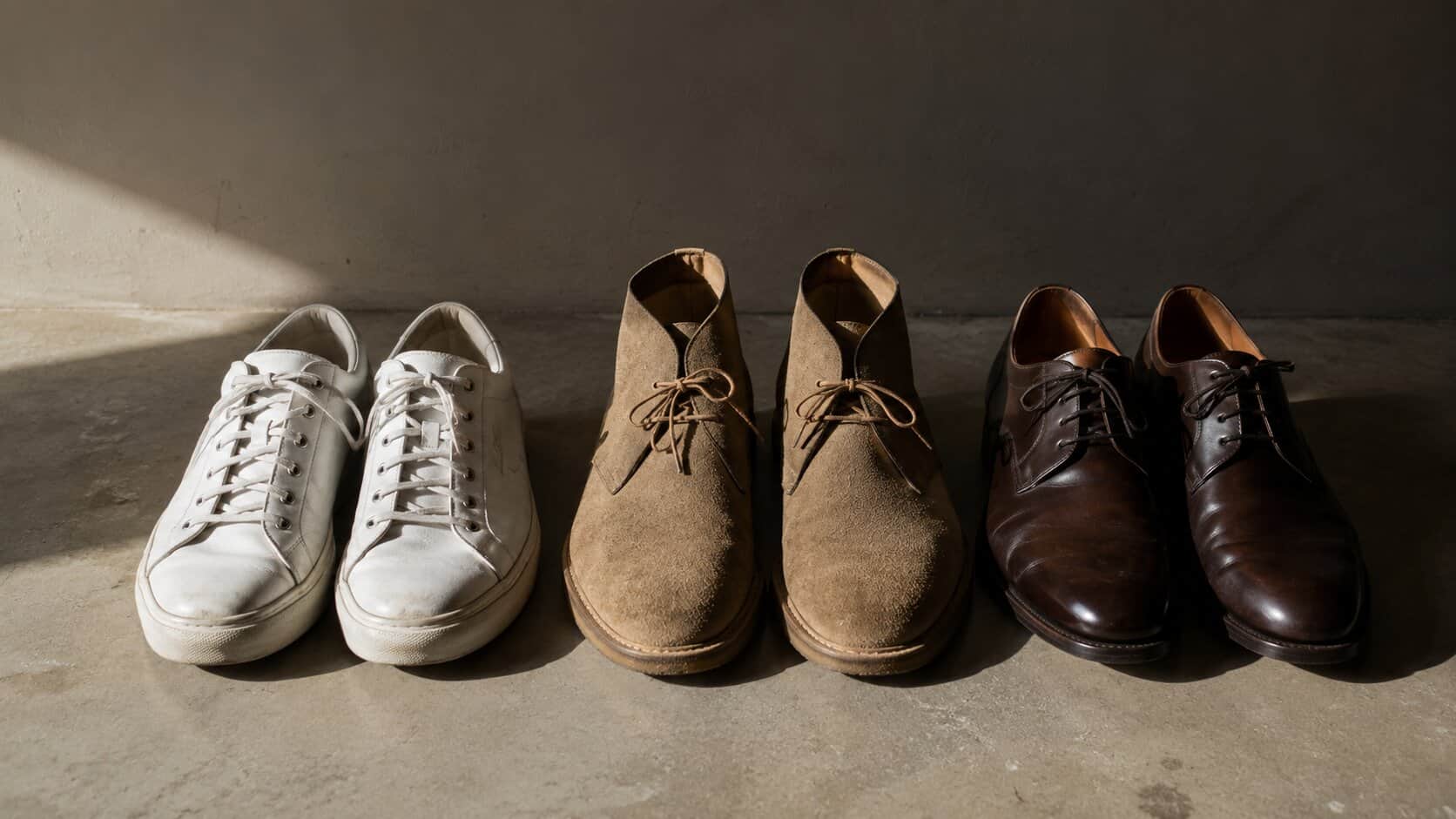
Run those over a shoe rack and the order falls out on its own. Sneakers are made for sport. A suede boot has a nap where a dress shoe has a shine. A polished derby sits a rung below an Oxford, and the Oxford is the top. None of that requires taste, and all of it is checkable by looking.
So how far apart is too far apart? Guy's answer is one level, and that is the version I counted: an outfit holds if its furthest-apart pieces sit within a single rung of each other.
Fourteen garments, priced and placed
The wardrobe is Antonio Centeno's core twelve, matched piece by piece to real listings in the MVRCK catalog, which is mine. Twelve lines come to fourteen garments, because one line is three T-shirts. It costs $4,961 at prices checked in September 2026, from an $80 tee to $690 flannels.
The twelfth line is an overcoat, a $431 navy wool and cashmere one here. It sits outside everything below, because a coat goes over whatever you have already decided on. It keeps you warm and it multiplies nothing.
The shape matters more than any single placement. Six tops, and four of them sit at the bottom two rungs. Nothing in the top row reaches level 4, which is where the derbies and the blazer live. The shoes are the only slot that spans the whole range, and they do it with a hole in the middle.
108 combinations, 24 that work
Six tops, three bottoms, three pairs of shoes, and the blazer either on or off. That is 108 outfits you could physically put on. Here is every one of them against the one-level rule, with a filled square where the combination holds.
| Bottom and shoes | White tee | Navy tee | Grey tee | Chambray | Oxford | Merino | Tops |
|---|---|---|---|---|---|---|---|
| Jeans, sneakers No jacket | works with White tee | works with Navy tee | works with Grey tee | works with Chambray | clashes with Oxford | clashes with Merino | 4 |
| Jeans, sneakers Navy blazer | clashes with White tee | clashes with Navy tee | clashes with Grey tee | clashes with Chambray | clashes with Oxford | clashes with Merino | 0 |
| Jeans, desert boots No jacket | clashes with White tee | clashes with Navy tee | clashes with Grey tee | works with Chambray | works with Oxford | works with Merino | 3 |
| Jeans, desert boots Navy blazer | clashes with White tee | clashes with Navy tee | clashes with Grey tee | clashes with Chambray | clashes with Oxford | clashes with Merino | 0 |
| Jeans, derbies No jacket | clashes with White tee | clashes with Navy tee | clashes with Grey tee | clashes with Chambray | clashes with Oxford | clashes with Merino | 0 |
| Jeans, derbies Navy blazer | clashes with White tee | clashes with Navy tee | clashes with Grey tee | clashes with Chambray | clashes with Oxford | clashes with Merino | 0 |
| Chinos, sneakers No jacket | clashes with White tee | clashes with Navy tee | clashes with Grey tee | clashes with Chambray | clashes with Oxford | clashes with Merino | 0 |
| Chinos, sneakers Navy blazer | clashes with White tee | clashes with Navy tee | clashes with Grey tee | clashes with Chambray | clashes with Oxford | clashes with Merino | 0 |
| Chinos, desert boots No jacket | clashes with White tee | clashes with Navy tee | clashes with Grey tee | works with Chambray | works with Oxford | works with Merino | 3 |
| Chinos, desert boots Navy blazer | clashes with White tee | clashes with Navy tee | clashes with Grey tee | clashes with Chambray | works with Oxford | works with Merino | 2 |
| Chinos, derbies No jacket | clashes with White tee | clashes with Navy tee | clashes with Grey tee | clashes with Chambray | works with Oxford | works with Merino | 2 |
| Chinos, derbies Navy blazer | clashes with White tee | clashes with Navy tee | clashes with Grey tee | clashes with Chambray | works with Oxford | works with Merino | 2 |
| Flannels, sneakers No jacket | clashes with White tee | clashes with Navy tee | clashes with Grey tee | clashes with Chambray | clashes with Oxford | clashes with Merino | 0 |
| Flannels, sneakers Navy blazer | clashes with White tee | clashes with Navy tee | clashes with Grey tee | clashes with Chambray | clashes with Oxford | clashes with Merino | 0 |
| Flannels, desert boots No jacket | clashes with White tee | clashes with Navy tee | clashes with Grey tee | clashes with Chambray | works with Oxford | works with Merino | 2 |
| Flannels, desert boots Navy blazer | clashes with White tee | clashes with Navy tee | clashes with Grey tee | clashes with Chambray | works with Oxford | works with Merino | 2 |
| Flannels, derbies No jacket | clashes with White tee | clashes with Navy tee | clashes with Grey tee | clashes with Chambray | works with Oxford | works with Merino | 2 |
| Flannels, derbies Navy blazer | clashes with White tee | clashes with Navy tee | clashes with Grey tee | clashes with Chambray | works with Oxford | works with Merino | 2 |
Twenty-four hold. Eight of the eighteen rows are empty end to end, which means eight bottom-and-shoe pairings in this wardrobe have no top that works with them at all. Chinos with sneakers is one. Jeans with derbies is another. So is a blazer over jeans and sneakers, which plenty of men wear and which Guy addresses directly: mixing highs and lows is possible, and doing it well takes an attention to detail the rule is there to spare you.
The placements are mine, so I tested how much they matter. Move every one of the fourteen garments a rung up or down at random, two thousand times over, and the formality check still removes more than half the 108 in 99.5% of those wardrobes. The exact number moves. The finding does not.
A wardrobe can also be built so that the check takes nothing at all, and it has to be small to manage it: seven pieces with nothing at either extreme make twelve outfits and lose none of them.
What the colour rules remove
Nothing. Not one of the 108.
Every garment in this wardrobe is white, navy, grey, blue, beige or brown. Every guide on this page lists those as neutrals in its own colour section, and every colour rule they teach exists to stop two loud things fighting. There is nothing loud in here to fight.
This is not a gotcha, and the guides are not wrong about colour. They answer it twice. The wardrobe advice at step two, buy neutrals, has already solved the colour problem before the colour chapter at step five arrives to solve it again. What survives step two is a formality problem wearing a colour problem's clothes, and it is the reason a closet of pieces you chose carefully still produces mornings where nothing goes with anything.
Three of the twenty-four
One from each end of the scale and one from the middle, all from the same fourteen garments. The prices are what those pieces cost in September 2026.
Saturday
Levels 1-2, and there are four of them
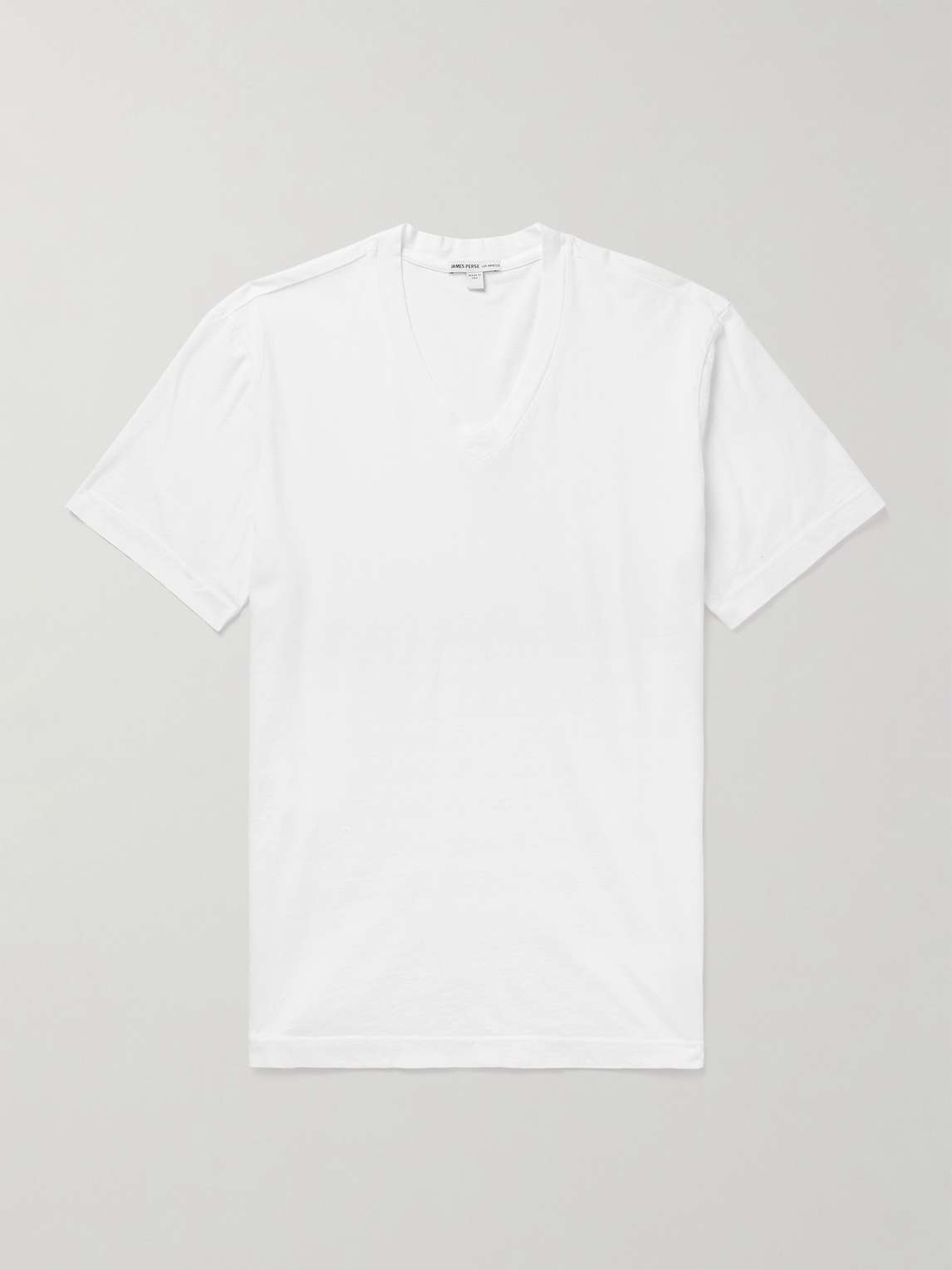
The whole casual end of this wardrobe is four outfits, and three of them differ only by the colour of the T-shirt. That is not a failure of imagination. At levels 1 and 2 the wardrobe holds three tees, one shirt, one pair of jeans and one pair of sneakers, so four is the arithmetic.


Most weekdays
Levels 2-3, where the boots start earning
Swap the sneakers for suede and the same shirt moves up a band. Suede is the reason: a nap reads softer than polished calf, which is what keeps this boot a rung below the derby and lets it reach down to the jeans as well as up to the flannels.


Anything with a table booked
Levels 3-4, which is fourteen of the twenty-four
More than half of everything this wardrobe can do sits in this band, because it is the only band where all four slots are filled. Two tops, two bottoms, two shoes and the option of the blazer, which is what fourteen outfits is made of.


The suede boots are in twelve of the twenty-four. The sneakers are in four. That gap is the clearest practical thing on this page: a shoe sitting one rung off the floor reaches three times as much of a wardrobe as a shoe sitting on it, and it is the same argument as the five rungs that separate a Saturday from smart casual, counted rather than described.
The check that happens at the till
The third check is proportion, and it will not go in the grid. Volume belongs in one place at a time: a roomy top over a leaner bottom, or the reverse, never both. Centeno gives the same rule and adds the corollary, that a full leg needs a shoe with some presence under it.
But that is not a fact about which pieces you combine. It is a fact about the cut you bought, so it is settled in the shop and cannot be undone by pairing. Of the three checks, one is decided at the till, one was decided the day you chose to build on neutrals, and one is left to do every morning. Only the third is a question about combinations, which is why it is the only one an outfit count can see.
Four things the count does not support
-
Twelve well-chosen pieces mean everything goes with everything.
Twenty-four of the 108 combinations hold up, so roughly one in five. And this is a good list: the reason 24 survive rather than 2 is that every garment on it is a neutral sitting within a rung or two of its neighbours. A worse twelve does worse. No twelve gets you everything with everything.
-
Colour is the hard part of putting an outfit together.
It removes none of the 108 here. Every garment in the wardrobe is white, navy, grey, blue, beige or brown, which every guide on this page lists as a neutral in its own colour section. The colour rule has nothing left to rule on, because the wardrobe advice printed a few paragraphs earlier already took the colours out.
-
Adding a formal piece adds formal outfits.
Black Oxfords are the most-recommended dress shoe there is and they add nothing to this wardrobe, because no shirt in it reaches their level. A piece only pays if something already owned can meet it. The white poplin shirt that would give the Oxfords a partner is worth eight outfits on its own, and the two together are worth more than either.
-
The formality rule is for tailoring, not for casual clothes.
The casual end is where it bites hardest. The sneakers, the most casual thing here, reach four of the twenty-four. The suede boots reach twelve. Sitting a rung off the bottom is what makes a piece combinable, and the pieces at the extremes are the ones with nowhere to go.
The piece worth buying next
Once the wardrobe is a count, the next purchase is a calculation rather than a preference. Add one garment and see how many outfits it turns on.
| The addition | Where it lands | Outfits it adds |
|---|---|---|
| A second pair of suede boots or shoes | Level 3, beside the desert boots | +12, from 24 to 36 |
| A fine-gauge navy polo | Level 3, beside the Oxford shirt | +9 |
| A white poplin dress shirt | Level 4, the empty cell in the top row | +8 |
| Black leather Oxfords | Level 5, above everything else here | None at all |
Two entries in the same slot, both the advice everyone gives, and one of them is worth twelve outfits while the other is worth none. The Oxfords fail because nothing in the wardrobe can meet them, not because they are the wrong shoe.
Be careful with the top row, though. A second shoe at level 3 adds twelve combinations, but they are the twelve you already had with different boots on, and twelve near-repeats are not obviously worth more than eight genuinely new looks. The count tells you where the wardrobe is thin. It does not tell you how much you want to wear the result.
That is the honest version of the question dividing a price by wears nobody has measured is trying to answer. Cost per wear asks you to forecast how often you will reach for something. How many outfits it completes with things already hanging up is the same question with the guessing taken out, and it is the one you can check.
It is also, more or less, why I built MVRCK. Photograph what you own and it becomes a wardrobe the stylist can see, so the ask stops being “what goes with this” and becomes “here are the six looks this shirt finishes with things you already have, and here are the two the other shirt finishes”. It works the same way on things you do not own yet: the catalog is real stock at real prices, you can put a look on your own avatar before spending anything, and it remembers your sizes and budget instead of asking twice. Every price on this page came out of it.
Common questions
How do you put an outfit together?
Pick the piece you actually want to wear, then match everything else to its level of formality. Formality is readable off the garment: smooth and plain and dark reads dressed up, textured and patterned and pale reads casual. Keep the palette to a couple of neutrals and one colour at most, and put the volume in one place rather than two. On a real twelve-piece wardrobe the formality check is the one that does the work, removing 84 of 108 possible combinations while the colour rules remove none.
What is the formula for putting an outfit together?
Anchor piece, then formality match, then palette, then proportion, in that order. The order matters more than the steps: the anchor decides the level, the level decides what can join it, and colour is a filter you have mostly already applied at the shop. Put This On has published the same rule since 2018, phrased as aiming everything towards one expression of formality.
How many outfits can you make from 12 pieces?
Fewer than the multiplication suggests. A published core twelve, which is fourteen garments once you count three T-shirts as three, works out at 108 mechanically possible outfits and 24 that survive a formality check. The usual claim, that a good core wardrobe means every piece goes with every other piece, is four and a half times too generous.
What is the 60-30-10 rule for outfits?
A dominant colour over 60% of the look, a secondary over 30%, an accent over 10%. It is an interior decorating rule, where the numbers mean walls, furniture and cushions, and the menswear pages teaching it say so themselves. It is fine advice and it is aimed at the wrong problem, because a wardrobe built on neutrals has no colour conflict left to resolve.
What colours go together in an outfit?
Blue, grey, brown and white go with each other and with almost anything, which is why every guide tells you to build on them. Keep two colour families carrying the look and let a third appear in something small. If two shades fight, push them apart in depth rather than swapping the hue: navy instead of mid-blue usually fixes it.
Why do my outfits look off even though I like every piece?
Because liking a garment and being able to place it are different problems. The most common version is a formality mismatch you cannot name: one piece is a rung or two off everything else, which reads as effort that did not land rather than as a mistake anyone could point at. Look at your shoes first. They are the piece most likely to be sitting at a level nothing else in the outfit reaches.
What I would do with all this: stop shopping for pieces and start shopping for rungs. Look at what you own, find the level where you already have the most things, and buy the next garment there rather than the one that looks most useful on its own. The most versatile piece in a wardrobe is never the one with the most uses in the abstract. It is the one with the most partners in yours, and a finished look priced whole is easier to judge than a garment photographed alone, for exactly that reason.
- How to Put Together a Successful Outfit · Derek Guy, Put This On
- The Formality Scale: How Clothes Rank From Formal To Informal · Sven Raphael Schneider, Gentleman’s Gazette
- A Simple Formula For Dressing Well · Brian Sacawa, He Spoke Style
- How To Dress Well: A Man’s No-BS Style Guide · Antonio Centeno, Real Men Real Style
- How to Dress Better for Men: 7-Step Style Guide · Klodsy
- The Essential Guide to Matching Men’s Clothes · Batch
- 60 30 10 Rule Outfit Men: 3 Color Combos That Work · Fashioned Travel
- Perfecting the 60-30-10 Rule in Your Living Space · The Spruce