Cost Per Wear: 30 Staples, and the Number Everyone Guesses
Seven cost-per-wear guides read in full contain zero real prices between them. So here are thirty menswear staples from $33 to $2,940, divided by the only garment lifespans anyone has measured. Ranking by cost per wear moves no piece more than four places.
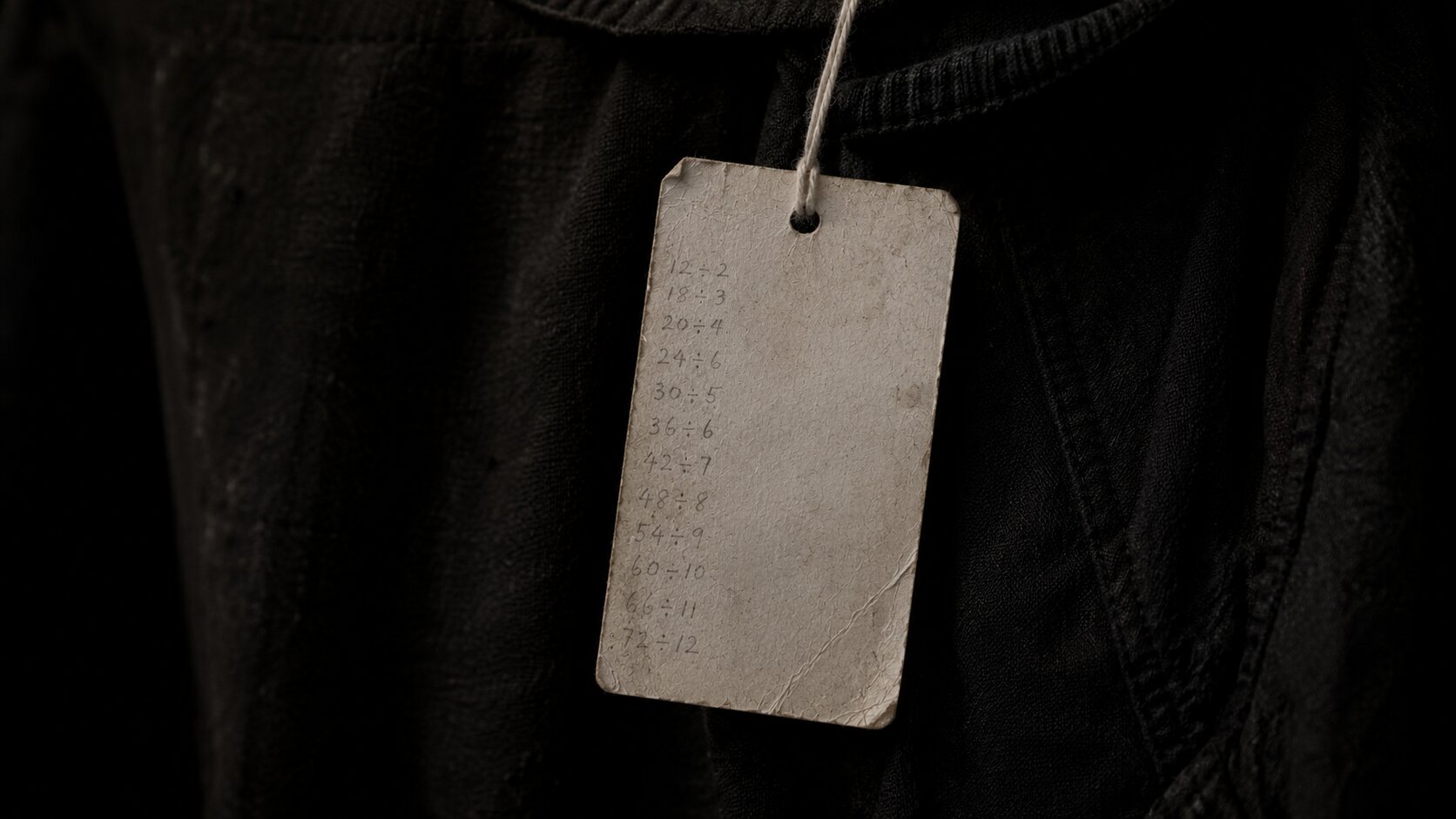
Cost per wear is the price of a garment divided by the number of times you wear it. Nobody disputes the formula. What nobody publishes is either number, so in September 2026 I took thirty menswear staples at their real prices, from a $33 pair of shorts to a $2,940 leather jacket, and divided each one by the lifespan its category has been measured at. The median comes out at $1.64 a wear. Nine of the thirty land under a dollar. And the ranking is almost identical to ranking them by price.
Which is the opposite of what the metric is sold as doing. The arithmetic is fine. The number everybody feeds into it is the problem.
$1.64
Median cost per wear across thirty staples priced from $33 to $2,940
4
Places the furthest-moving piece travels when the thirty are ranked by cost per wear instead of price
0 of 7
Cost-per-wear guides read in full for this page that name a single garment at a price you could check
Nobody is arguing about the formula
Price divided by wears. It is unit pricing for clothes, the same idea supermarkets use when they put a price per 100g on the shelf edge, and it has one good piece of research behind it. Lisa Eckmann at the University of Bath and Lucia Reisch at Cambridge Judge ran six preregistered experiments on it, published in Psychology & Marketing in October 2025. Showing people a cost-per-wear figure moved them toward the better, more expensive garment.
Two of their findings are the ones worth carrying around. The effect only appeared when people could compare two garments' figures against each other; shown next to a single item it did nothing. And it disappeared for occasion wear, working only on things bought for everyday use.
The second finding is the uncomfortable one. The metric stops working precisely where people reach for it hardest, which is standing in front of a suit they will wear to one wedding.
Eckmann's own worked example, written up in The Conversation, is a man buying a work shirt he will wear once a week, “so roughly 50 times per year”. A £20 shirt that lasts a year costs 40p a wear. A £50 shirt that lasts four years costs 25p. She also notes that durability could be measured properly, by the abrasion cycles a fabric survives, and that no shop does it.
Seven guides, and not one real price
So the concept is sound and the research is real. Then you read what gets published about it. I read the seven cost-per-wear guides ranking for the term in September 2026, in full, and counted the garments in them you could go and buy.
| Guide | Its worked example | Where the wear count comes from |
|---|---|---|
| AOL | $60 coat, 25 wears. $220 coat, 125 wears. | Unattributed. Carries the line “This article was created by content specialists using various tools, including AI.” |
| Woman’s World | $60 coat, 25 wears. $220 coat, 125 wears. | Unattributed, and the same five examples as the AOL piece published the day before. |
| Boring Label | 1,200-rupee tee, 100 wears. 400-rupee tee, 25 wears. | A table of annual wear counts by garment type, offered as “rough anchors” with no source. |
| The Frugal Glow | $100 coat, 50 wears so far. $80 wool coat, 120 wears. | The author’s own recall of coats she owns. |
| The Dollar Stretcher | $100 shoes, 50 wears. $100 dress, 2 weddings. | Step two of its method is “guesstimate how often you will wear the garment”. |
| Cotton Cashmere Cat Hair | $100 coat, 20 wears. | Her own wardrobe, logged daily in a closet app. The only measured denominator of the seven. |
| CostPerUse | $45 boots, one winter. $250 boots, ten years. | Lifespans stated as fact, with no source and no testing behind them. |
Zero. Not one names a brand, a product or a price you could check. Every example is a round number holding a slot: a $100 coat, an $80 pair of jeans, a $25 top, a $150 dress. Three of the seven use exactly $100. The two published a day apart, at AOL and Woman's World, run the same five examples, the same two expert quotes and the same industry statistic, and the first of them says at the foot that it was made with AI.
Credit where it is due: one of the seven works from a wardrobe she logs daily in a closet app, which is the only measured denominator on the list, and she is careful to say a good figure is personal rather than universal. She is also the one with the least reach.
This is a metric whose entire value is that it replaces a feeling with a number, and the genre that promotes it has been running on made-up numbers for a decade. That is the gap worth filling, and it is the same job as reading twelve nightlife dress codes end to end rather than repeating what everyone says they contain.
The one number somebody has measured
Half of cost per wear is public: the price is on the tag. The other half needs to know how long a garment survives, and there is exactly one serious dataset on it, which the entire cost-per-wear genre appears never to have opened.
WRAP, the UK climate NGO, surveyed 6,000 people about 44,807 individual items of clothing in late 2021, asking of each how long ago it was acquired and how much longer it would be worn. Coats came out at 6.3 years, jackets at 6.1, jeans at 4.1, T-shirts and polos at 4.0, and clothing overall at 4.3. Every one of those is longer than the 2013 figures. A repair adds 1.3 years on average.
There is one thing WRAP measured that changes how you read the rest: a quarter of what people own, 31 items out of an average wardrobe of 118, had not been worn at all in the past year. Clothes are not failing early. They are sitting still.
How the numbers below were worked out
Wears equals how often you wear a thing multiplied by how long it lasts. WRAP supplies the second term. For the first, the rate is Eckmann's own, once a week or 50 wears a year, applied to every piece.
That is deliberately the best case. A garment in genuine weekly rotation for the whole of its measured life is the ceiling, not the average, and almost nothing you own will hit it. The ceiling is the number worth knowing anyway: if a piece fails the test at its best case, it fails.
| Category | Measured life | Wears at once a week | Source |
|---|---|---|---|
| Coats, not padded | 6.3 years | 315 | WRAP, 2022 |
| Jackets | 6.1 years | 305 | WRAP, 2022 |
| Jeans | 4.1 years | 205 | WRAP, 2022 |
| T-shirts, polos, jersey tops | 4.0 years | 200 | WRAP, 2022 |
| Everything else here | 4.3 years | 215 | WRAP’s all-clothing average, used where no separate figure is published |
Two limits, stated rather than buried. WRAP surveyed clothing, not footwear, so the five shoe rows below borrow the all-clothing average and are the softest figures on the page. And WRAP's respondents are in the UK while the prices are US, which is the kind of seam that exists in any calculation combining two honest sources and is better named than smoothed over.
Thirty staples, priced and divided
Thirty pieces that a man building a wardrobe would recognise, across nineteen houses, every one a real listing in the MVRCK catalog, which is mine, at a real price. No piece appears twice. They are ranked by cost per wear, most expensive first, with their position in the same thirty ranked by price sitting in the last column.
| # | The piece | Price | Wears | Per wear | By price |
|---|---|---|---|---|---|
| 1 | $2,940 | 305 | $9.64 | 1 | |
| 2 | $2,070 | 215 | $9.63 | 2 | |
| 3 | $1,845 | 215 | $8.58 | 3 | |
| 4 | $1,520 | 200 | $7.60 | 4 | |
| 5 | $1,250 | 215 | $5.81 | 6 | |
| 6 | $1,420 | 315 | $4.51 | 5 | |
| 7 | $725 | 205 | $3.54 | 8 | |
| 8 | $550 | 200 | $2.75 | 11 | |
| 9 | $590 | 215 | $2.74 | 9 | |
| 10 | $755 | 305 | $2.48 | 7 | |
| 11 | $520 | 215 | $2.42 | 12 | |
| 12 | $510 | 215 | $2.37 | 13 | |
| 13 | $590 | 305 | $1.93 | 10 | |
| 14 | $385 | 215 | $1.79 | 15 | |
| 15 | $375 | 215 | $1.74 | 16 | |
| 16 | $330 | 215 | $1.53 | 17 | |
| 17 | $295 | 200 | $1.48 | 18 | |
| 18 | $448 | 315 | $1.42 | 14 | |
| 19 | $295 | 215 | $1.37 | 19 | |
| 20 | $285 | 215 | $1.33 | 20 | |
| 21 | $237 | 215 | $1.10 | 21 | |
| 22 | $210 | 215 | $0.98 | 22 | |
| 23 | $195 | 215 | $0.91 | 23 | |
| 24 | $175 | 215 | $0.81 | 24 | |
| 25 | $145 | 215 | $0.67 | 26 | |
| 26 | $125 | 215 | $0.58 | 27 | |
| 27 | $171 | 305 | $0.56 | 25 | |
| 28 | $96 | 215 | $0.45 | 28 | |
| 29 | $80 | 200 | $0.40 | 29 | |
| 30 | $33 | 215 | $0.15 | 30 |
The spread of prices is 89 to 1. The spread of cost per wear is 64 to 1. Dividing by the best lifespan data available compresses an 89-fold difference into a 64-fold one, and that is the whole of what the metric achieves here.
Sorting by cost per wear barely changes the order
Read the last column downward. It runs 1, 2, 3, 4, 6, 5, 8, 11, 9, 7 and carries on like that to the bottom. Reordering thirty garments by cost per wear rather than price moves no piece more than four places.
The reason is arithmetic, not taste. The denominators available to these thirty pieces run from 200 wears to 315, a spread of 1.6 to 1, because that is how little garment lifetimes differ between the longest-lived and shortest-lived categories on this page. The prices run 89 to 1. When one input varies by 89 and the other by 1.6, the first one decides the answer and the second is a rounding adjustment.
The furthest mover in the whole set is A.P.C.'s trench coat, which drops four places down the ranking. On a list running from worst to best that means it comes out four places better than its price alone would put it, and it earns that by being a coat, the category with the longest measured life of any. Three more pieces move three places. Nothing else moves more than two. That is the metric's entire corrective power over a price tag.
Which is worth holding against how cost per wear is usually sold, including by people arguing in good faith: as the calculation that reveals the expensive thing to have been the cheap thing all along. On real prices it mostly reproduces the price list. It is the same pattern as the suede loafers that cost less than the sneakers they dress up, in reverse: the relationship people assume between money and value in a wardrobe is weaker than it feels in both directions.
The denominator is the whole game
So if the category barely matters and the price mostly just reasserts itself, where does cost per wear move? Into the only variable left, which is how often you take the thing off its hanger.
Here is one garment from the table, at one price, under four honest patterns of use.
Washed cotton-chambray shirt, Ralph Lauren
$125
- Five wears, then it stops coming out $25.00
5 wears
- Once a month for a year $10.42
12 wears
- Twice a month for its full measured life $1.21
103 wears
- Once a week for its full measured life $0.58
215 wears
A 43-fold spread, on one garment, with the price held still. The entire thirty-piece table above spans 64-fold. Almost the whole range of that ranking is reachable inside a single $125 shirt, purely by how often it gets worn.
Put the two ends of the table against each other and it stops being abstract. Loro Piana's cashmere sweater at $2,070 comes to $9.63 a wear if you live in it. The Ralph Lauren shirt at $125, worn once a month for a year and then forgotten, costs $10.42. The sweater is sixteen times the price and cheaper every time you put it on.

The second most expensive piece on this page and the second worst on cost per wear, at $9.63 a wear in the best case. It is on the list because it is also the clearest illustration of the point: brushed cashmere at this price only makes sense at high rotation, and at high rotation it beats a cheap shirt you ignore. No shop publishes this figure at all, and the research suggests why luxury houses in particular never will: the study warned that a brand at this end risks undermining itself by advertising how cheap its clothes are per wear.
Loro Piana
Fobello Cashmere Sweater
$2,070

Fourth cheapest cost per wear on the page at $0.56, and it got there by being marked down 70 per cent rather than by anything about how it is made. At its full $570 the same jacket is $1.87 a wear, which is thirteen places worse. Nothing about the garment changed. This is the part of the metric people forget: it is a function of what you paid, not of what the thing is.
Mr P.
Recycled-Shell Field Jacket
$171 $570
Four things the arithmetic does not support
-
Cost per wear turns the expensive thing into the cheap thing.
Not on thirty real garments it does not. Reorder them by cost per wear instead of price and no piece moves more than four places out of thirty. The denominator varies by a factor of 1.6 between the longest-lived and shortest-lived categories on this page. The prices vary by a factor of 89. One of those numbers decides the ranking, and it is not the one the metric was invented to correct for.
-
The formula settles the argument at the till.
It settles nothing until the denominator is filled in, and the denominator is a forecast about your own future behaviour made by the person who wants to buy the thing. Six preregistered experiments found the metric only shifts a decision when you can compare two garments’ figures side by side. On its own, next to one garment, it did nothing.
-
Higher quality is what brings the number down.
Quality sets the ceiling on the denominator. Nothing more. A coat that survives six years still costs $50 a wear if it leaves the wardrobe six times, and no amount of full-grain anything fixes that. On this page the discounts move the arithmetic harder than the construction does: the field jacket at $171 lands at $0.56 a wear, and at its $570 full price it would be $1.87.
-
The metric works the same on everything you buy.
It measurably does not. The same experiments found the effect disappears for occasion wear, which is exactly the category where people reach for the calculation hardest to justify the purchase. The wedding suit is where cost per wear is least useful and most often invoked.
None of that makes cost per wear useless. It makes it a comparison tool rather than a justification tool, which is what the research found and what almost nobody uses it as. Run it across two shirts you are choosing between and it will tell you something. Run it on one thing you have already decided to buy and you will produce whatever answer you went in wanting, because you are the one supplying the denominator.
What decides whether you reach for it
The denominator is not about discipline, and telling people to wear their clothes more has never worked. A garment gets worn when there is an outfit waiting for it. The pieces that rack up wears are the ones that finish four different looks with things already in the wardrobe; the ones that stall are the ones that finish exactly one, which is why WRAP's respondents named “for occasions only” as a leading reason for the 31 items they had not touched all year. Counting those looks before you buy is its own exercise, and on a real twelve-piece wardrobe only a fifth of the combinations hold up.

At $125 it needs 215 wears to reach 58 cents, and it is the piece on this page most likely to get them. A washed chambray shirt goes under a blazer, over a T-shirt, open with the sleeves rolled, or on its own with wool trousers. It is not the best-made thing here and it is nowhere near the most expensive. It is the one with the most jobs, and the number of jobs is what the denominator is counting.
Ralph Lauren
Slim-Fit Washed Cotton-Chambray Shirt
$125
That is the count worth having before you buy anything, and it is the one nobody can do in their head, because it depends on the other forty things hanging up. It is what I built MVRCK to do. Photograph what you own once and it becomes a wardrobe the stylist can see, so the question stops being “will I wear this a lot” and starts being “here are the six outfits this shirt completes with pieces you already have, and here are the two the other shirt completes”. It remembers your sizes, brands and budget, you can see any look on your own avatar before spending anything, and the catalog behind it is real stock at real prices, which is where the thirty figures above came from.
Cost per wear asks you to predict the future. This is the closest thing to checking.
Common questions
What is cost per wear?
The price of a garment divided by the number of times you wear it. A $125 shirt worn 215 times costs 58 cents a wear. The same shirt worn 12 times costs $10.42. The formula is not in dispute anywhere. The second number is, because almost nobody measures it and everybody estimates it in their own favour.
How do you calculate cost per wear?
Price divided by wears. The price is on the tag. The wears are how often you wear it in a week multiplied by how long it lasts, and only the second half has ever been measured: WRAP puts jackets at 6.1 years, jeans at 4.1, T-shirts and polos at 4.0 and clothing overall at 4.3, across 44,807 items. The first half is a forecast you are making about your own behaviour, and it is the half that decides the answer. Add tax, shipping and alterations to the price if you want to be strict about it.
What is a good cost per wear?
There is no published benchmark, which is worth saying plainly rather than inventing one. For reference, thirty menswear staples priced from $33 to $2,940 in September 2026 come out at a median of $1.64 a wear if each is worn once a week for its full measured life. Nine of the thirty land under a dollar. That is the best case, not the expected case.
Does cost per wear justify buying expensive clothes?
Less often than it gets used to. Rank thirty real garments by cost per wear and you get almost the same order as ranking them by price, because prices vary far more than garment lifetimes do. Where it helps is comparing two specific options side by side, which is the one condition the research found it working under. Where it fails is talking yourself into something you already want.
Where does the 30 wears rule come from?
The 30 Wears Challenge, started by Eco-Age co-founder Livia Firth and the journalist Lucy Siegle in 2015. The question is whether you will wear a thing at least thirty times before you buy it. It is a good question and a low bar. Thirty wears is under eight months at once a week, and every category in the table on this page survives four years or more.
Do clothes last long enough to reach a low cost per wear?
Yes, and longer than they used to. WRAP’s 2021 survey of 44,807 garments found jeans lasting 4.1 years against 3.1 in 2013, and T-shirts 4.0 against 3.3. Repairing something adds 1.3 years on average. The problem is not that clothes wear out early. It is that a quarter of what people own, 31 items out of an average 118, was not worn at all in the past year.
What I would do with all this: stop using cost per wear to decide whether to buy something, and start using it to decide which of two things to buy. The first job is a rationalisation with arithmetic on top. The second is the only one it has ever been shown to do. And if the two figures come out close, which on real prices they usually will, buy the one that goes with more of what you already own.
- Shifting Toward Quality: How Communicating “Cost per Wear” Influences Consumer Preference for Clothing · Eckmann and Reisch, Psychology & Marketing
- Showing shoppers the ‘cost per wear’ of their clothing choices could make fashion greener · Lisa Eckmann, The Conversation
- Labelling clothes with cost per wear could curb fast fashion, shows research · University of Bath
- Citizen Insights: Clothing Longevity and Circular Business Models Receptivity in the UK · WRAP
- Valuing Our Clothes: the cost of UK fashion · WRAP
- How long should your clothes last? · Harper’s Bazaar UK
- Cost-per-wear: the simple math formula that’s quietly changing how Americans shop · AOL
- Cost Per Wear: The Closet Math Quietly Ending Buyer’s Remorse · Woman’s World
- Cost Per Wear: The Only Clothing Maths You Need · Boring Label
- The ‘Cost Per Wear’ Formula: Why a $100 Coat is Cheaper Than a $30 Fast-Fashion One · The Frugal Glow
- How a Cost-Per-Wear Clothing Budget Can Help You Save · The Dollar Stretcher
- Cost Per Wear: What It Means + How to Calculate · Cotton Cashmere Cat Hair
- The Ultimate Guide to Cost per Wear · CostPerUse